Six Things to Know About Stella and Dot Stylist Kristina Hagerty

I met Stella and Dot Stylist Kristina Hagerty last year through a series of meetups and jewelry parties and was immediately intrigued by the Stella and Dot story, and especially her role entrepreneurial role in at the “social shopping” company.

Why did you decide to work with Stella and Dot?

I previously worked in International Trade for 5 years but have always had a love of fashion and marketing. I was inspired by the entrepreneur spirit of Stella & Dot and the opportunity to do what I love, style!

What interested you in jewelry styling in the beginning?

I’ve always been highly creative. I used to style my mom and friends growing up. I love the texture of jewelry and how it can literally transform an outfit. I used to make my own jewelry to go with my outfits!

How do you define your personal style?

Romantic, dreamy, sleek, modern, BOLD!

Photo by Ashley Batz

What have been some of the highlights of your Stella & Dot career so far?

Giving a style presentation to a room full of ladies at one of the events I was invited to attend. Receiving heartfelt thank you’s from my customers, seeing all the fun the ladies are having at my trunk shows and more than anything the people I’ve met. They are amazing. I love to meet new people and I’ve developed some fantastic friendships along the way!

How do you incorporate social media with your business?

I have a Facebook fan page where I post photos of how to wear the pieces and get my fans involved in the creative process. It’s so wonderful to hear all their creative suggestions; it’s a team effort! I also have a Twitter account (@kristinaviajera) where I interact with others, post trend reports and awesome promotions! In addition I have my own boutique where you can check out all the jewels and sign up to do a trunk show with me! Check it out at www.stelladot.com/kristinahagerty.

Who do you typically work with?

My clients are very diverse and of all ages! Sometimes I am helping someone pick out a piece for an event or a wedding, but more often than not I am picking out and suggesting pieces that work with [women’s] everyday wardrobes. There are so many fun ways to accessorize and accentuate your personal style and I love helping women find pieces they love while they have a chance to relax, socialize and have a glass of wine!

A few photos of an event Kristina threw recently:
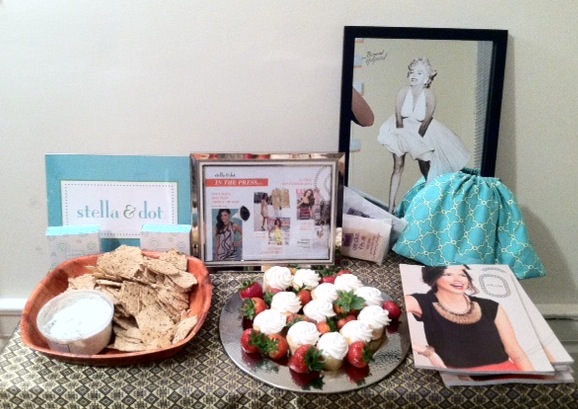
See the rest of the photos on my Facebook fan page. And while you’re at it, check out Kristina’s fan page as well!


ShopNear.Me Merges the Worlds of Online and Offline Shopping

Whenever I go shopping for clothes in San Francisco I tend to just focus on the area around Union Square. Two reasons: I know what I want and where I want it there, and I’m usually short on time. But it’s nice to know that I can cut down on time even further by using ShopNear.Me.

The App’s Usability

ShopNear.Me a new iOS app that gives users information about sales and arrivals at stores they care about. Users can also set up alerts for their favorite stores, and browse the app by products so as not to miss out on a great piece by sticking to their usual stores. Without waiting until there’s time to visit new stores on a whim, users can browse products in their San Francisco neighborhood of interest for goodies they love. Though right now the app features mainly boutiques in Hayes and the Marina, the team is working to expand coverage into the Mission and SOMA.

And the best part, is that coming soon, users will be able to reserve items while on the go.

You won’t have to be torn between seeing an alert go by about beautiful shoes you don’t want to miss out on or attending a startup’s launch party. You can do both!

The Team

I recently had a nice chat with co-founder Yuan Zhang, whose role entails business development, marketing, PR, raising funding, and investor relationships. Phew! But she said it doesn’t feel like work.

According to Zhang, shopping is “a visual experience”, and this app fits that desire of consumers. There are apps out there that list store directories, or sites like Yelp, where users can write reviews of their shopping experiences, but no real visual way to find out what’s inside stores in the area quickly. (Talk about finding a perfect niche in need of some help).

Other team members include Programmer Ben Wong and Designer Loc Ngo (co-founders of Startuply), and Programmer Steve Zu (formerly of social gaming company Lolapps).

The Boutique Perspective

To get the boutique perspective, I took a quick trip to meet with Marissa Olson, Owner of Chloe Rose, a women’s clothing boutique on Union Street.

Olson, in no way new to fashion, or online marketing, said what first drew her to using the app for her store was that she was approached about it.

She finds that to keep her store running smoothly and market online, she does what every boutique owner should do- she has a checklist of promotional things she does. She updates Facebook and Twitter at least once a day if possible and ShopNear.Me when new items arrive in the store.

ShopNear.Me really offers a “store front” to boutiques. With the pretty pictures and thoughtful search options, I’m excited to watch this app take off.


The Story of Snapette, an iOS Fashion App

I can’t tell you the number of times when I’ve been out and about and seen an amazing shoe that I took a picture of to text to my mom or one of my girl friends. In the end, these pictures would either end up saved on my phone or eventually deleted. But now I am able to save all photos to one place, Snapette, where other fashion fans will be able to enjoy my finds and I am able to see theirs too.

Last Friday, I sat down with Sarah Paiji, a co-founder of Snapette, and she told me the story of how this cool new fashion app came to be.

The Story

Sarah Paiji, originally from a suburb of LA, found herself on the East Coast for the past 8 years, including time in school at Harvard and working for Goldman Sachs, McKinsey & Co and Berkshire Partners. Most recently before Snapette, Paiji was studying at Harvard Business School. It was through an HBS alumni event where she met Jinhee Kim, an HBS alum more than two decades her senior, and more importantly, a woman with a very big idea.

Source: Snapette.com

According to Paiji, the two had a short meeting over coffee, after meeting at a Harvard alumni event. Soon after, Kim invited Paiji to spend her January 2011 term with the Kim family in London… to launch a company. Snapette.

With “no dominant social app yet” in fashion, and mobile being a space with such great growth potential, Paiji decided this was a chance too good to pass up.

After the two recruited a technical person to join their team (and for a month in London), the real work began.

Luckily, a tweet Paiji made about their new app was found by Dave McClure of 500 Startups, a startup incubator located in Mountain View, and soon McClure was inviting the Snapette team to relocate to California and work from the 500 Startups office space.

Just yesterday, 500 Startups hosted its second ever Demo Days, a place for its entrepreneurs to present their ideas to investors and press. The Snapette team presented, along with more than 20 other startups, as the culmination of their 3 month period in the 500 Startups accelerated program.

Think about it, within 8 months, Snapette went from an idea, to a company, and to a company that publications like Forbes and VentureBeat are now covering. That is pretty inspiring.

The App

Paiji describes the app as this: like Milo for fashion.

Source: The Fashionable Bambino

Snapette lets users upload an unlimited amount of content to the app (available on iPhone, iPad, and iPod Touch) and browse other users’ finds as well. For now, users can see shoes and bags that others have uploaded from around the world, and content uploaded by nearby stores. Users are able to search by brand, store, description, or “New”, “Near”, and “Hot” ratings of products.

And of course, there is further social integration with sites like Facebook.

Right now the Snapette team is focusing its efforts on working with boutiques in New York, LA, San Francisco, and London, including San Francisco-based boutiques like Heidi Says and Gimme Shoes.

Why stop with shoes and bags? Well for now, the Snapette team decided to just start with those products because “women are passionate about them”, according to Paiji.

Within 6 months, Paiji hopes to see the team add more features to Snapette and figure out whether to decide to focus more on fashion or the social experience.

*Note: A big thank you to Hong Quan of 500 Startups for the introduction.

Branding in Motion: Part 4 of 4

An interview with Russell Volckmann on Branding in Motion

Image by Extra Medium

Ashley: Should (online) fashion brands keep anything extra in mind that brands in other markets may not have to worry about?

Russell:

Like any brand, fashion brand goods also require unique and lasting brand features to be successful in the market. Fashion, as the term implies, is fleeting. And herein lies a unique challenge for fashion brands–or any other fast moving consumer products (also called, “fast consumer”). How to maintain a solid unwavering and strong brand foundation, while at the same time maintaining the perception of a high level of innovation that customers expect is important, which requires constant change in brand expression. The answer will be different for each unique brand, but the challenge is the same.

Also, differentiation on the basis of brand is vitally important in case of fashion because competition is very high and each fashion brand needs to say something different. Without the differentiation created in the brand (including the product expression of that brand), the fashion brand can easily fall into becoming a commodity. And like all other commodities, the product becomes price or value based, rather than aspirationally based. Commoditization can kill any company, fashion or not. When price becomes the primary reason people buy, your fashion brand will always be susceptible to someone cheaper. In other words, fashion brands need to maintain a high level of aspiration (to buy) among customers. Specifically, I think attention to target lifestyle is key.

Interestingly, established luxury brands continue to do well even in down markets because they maintain that high level of quality and aspiration. Price may be more important in slow times, but customers often turn to lasting quality anyway, abandoning the cheaper, disposable, less innovative, lesser quality alternatives. Whatever target price point or customer, a fashion brand needs a clear proposition of fashion and value that is unique and drives brand expressions faithfully.

Part 1 > What are some key things to consider when creating an online based brand?

Part 2 > What sort of “due diligence” should brands do when conceptualizing their name/logo/etc?

Part 3 > What’s the first thing an (online) brand should do if they have a #prfail (they really mess up online)?

Branding in Motion: Part 3 of 4

An interview with Russell Volckmann on Branding in Motion

Image by Extra Medium

Ashley: What’s the first thing an (online) brand should do if they have a #prfail (they really mess up online)?

Russell:

Very relevant question and interesting in the way it was phrased. It implies a PR answer, but in fact more relevant for the brand attributes that need to drive the PR answer. In a sense, due diligence for any brand planning should be a disaster planning exercise also. Life happens, people mess up. However, by remaining faithful to the key attributes of your brand that early on should have been developed, those attributes should provide the answer to cleaning up messes.

The nuances of that PR response may be different for each company, but I think the basic tenets remain the same. Whatever nuances help shape the answer, the key is to be honest, authentic, and genuinely care enough to solve the challenge openly and by involving the stakeholders affected by the problem or challenge. Employees. Customers. Communities. The world. Because if you don’t do these things, and stay in alignment with your brand values, people will see right through the facade and begin shaping your brand in ways far worse than the mess-up itself. Sometimes irreparably so. As I mentioned at the beginning of our conversation, no brand can hide from the Internet, which has become a very dynamic and constantly moving forum for your brand.

Next time > Should (online) fashion brands keep anything extra in mind that brands in other markets may not have to worry about?


Part 1 > What are some key things to consider when creating an online based brand?

Part 2 > What sort of “due diligence” should brands do when conceptualizing their name/logo/etc?

Part 4 > Should (online) fashion brands keep anything extra in mind that brands in other markets may not have to worry about?

Branding in Motion: Part 2 of 4

An interview with Russell Volckmann on Branding in Motion


Image by Extra Medium

Ashley: What sort of “due diligence” should brands do when conceptualizing their name/logo/etc?

Russell:

“Due diligence” is an apt term, and not performing due diligence can be very costly to a company. A company needs to perform a great deal of proper positioning and planning before getting to the point of expressing the brand in terms of a company name, product name, visual identity (logos, word marks, supporting graphical devices), or other brand expressions. Spending the time and effort performing this initial due diligence will reap great rewards. The positioning and planning leads to vital platforming on which all brand expressions are built. Conversely, skipping important brand development steps leads to uninformed choices. Uniformed choices in brand will lead to mistakes in developing brand expressions such as logo or name, for example. As a building with no foundation will topple over, so will a brand without its proper platform or foundation.

Typically companies should not attempt to perform brand development in-house, and rather hire an outside professional branding agency or professional consultancy. Why? A high expertise level of respected and expert branding professionals is one reason. Another reason is that it is nearly impossible to be objective with one’s own brand. Companies tend to overlook or are unaware or vital questions concerning their brands. And a great deal of challenges await brand development internally, externally, and in the interaction between both. A simple metaphor is looking in the mirror and not seeing what everyone else is seeing.

Since the logo is something everyone recognizes as one brand expression, let’s continue to use the logo as an example.

One symptom of not performing due diligence is the common mistake of hiring graphic designers for a logo. Companies often choose designers simply because they can design, and without looking at key market, business, brand landscape (brandscape)–plus other objectives and challenges that need to drive the visual expression of that brand identity. Successful logos are not designed in a vacuum, nor are they the result of ‘liking’ or ‘not liking’ the design. And this is where so many visual identities fail.

Rather, a successful visual identity is driven by numerous factors and objectives that a logo, for example, needs to accomplish. Does it differentiate? Does it resonate with key customers? Is it flexible enough to work in a near infinite variety of environments? On products? Online? Is it immediately recognizable? Does it communicate the key drivers uncovered early on during a comprehensive brand discovery and platforming process? Will it outlast fads? Is there potential for lawsuits due to similar aspects causing intellectual property infringement? Is it meaningful? Does it resonate with company internal stakeholders after a proper gestation period? People gravitate toward the familiar because they feel comfortable with it. However, feeling familiar means doing things the same as everyone else, which does not differentiate, and therefore offers no unique value to stakeholders (internally or externally). Otherwise, no reason for anyone to buy. So, now you see why ‘liking’ or ‘not liking’ really has nothing to do with how a successful logo or visual identity is developed. Yes, a logo should work aesthetically. But like so many other brand expressions, a logo needs to create a meaningful brand experience. And thankfully, expert brand agencies have processes for getting brands there.

Next time > What’s the first thing an (online) brand should do if they have a #prfail (they really mess up online)?

Part 1 > What are some key things to consider when creating an online based brand?

Part 3 > What’s the first thing an (online) brand should do if they have a #prfail (they really mess up online)?

How Moxsie’s BuyerChat Keeps Twitter Followers Engaged

There are more fashion brands and e-tailers on Twitter today than I can count, but only a handful that really stand out from the pack. Creativity, a clear voice, and audience participation must be components. And @Moxsie has all three.

Since October 2010, the San Francisco-based indie fashion e-tailer has been tweeting its BuyerChat events as a way to get its Twitter community more involved with choosing the types of clothing that gets sold on the site. BuyerChat participants may also have the chance to “attend” a behind-the-scenes look at new arrivals, buying meetings, and photo shoots.

According to Marketing Creative Manager Mayka Mei, the growth in participating has been interesting to watch.

“We see aspiring stylists bringing in their partners to participate, and we have a large enough group now that makes our impromptu introduction of #team[whatever] more meaningful. The greatest reward for administering BuyerChat on this end is watching our group of “regulars,” returning,” Mei says.

The event was created after the Moxsie team realized their community on Twitter (over 149,000 followers strong) would give them the opportunity to connect with fans they’ve never met in person.

“Moxsie specifically works with independent designers, so a lot of these companies don’t have the time or resources to focus solely on their social media,” Mei says. “Since Moxsie has such a devoted following, it’s just one thing we can do: leverage the opinions of the people who know the market best (the market themselves) – and it gives our designers exposure, too, of course.”

To date, Moxsie has held more than fourteen BuyerChats through which participants and winners were issued badges.
One Twitter participant, @JennieB, a veteran of the fashion industry, has participated in more than 10 such events.

@JennieB found Moxsie through doing research about social shopping sites selling indie designers’ clothes, and subsequently followed the brand on Twitter.

“I like the interaction with other Moxsie fans, with Moxsie themselves and I like that the company is actually having a conversation with me/us – and reacting to the things we say,” she says. “Moxsie has a great ‘voice’- clever and a little sassy, but also they come across as really nice.”

To date, @JennieB is one of just four people who have achieved the top status, “Buyer Guru”. She’s also won two $50 prizes for contributing the best tweet.

Think you can keep up? Visit http://shop.moxsie.com/buyerchat and sign up for the next BuyerChat, taking place today, March 23rd, at 2 pm PST. Follow @Moxsie on Twitter, and start chatting using the #buyerchat hashtag.

Something Old, Something New: An Interview with Wearable Tech Designer Joanne Hodge

Though there are some fabulous collections going down the runways during New York Fashion Week right now, sometimes in fashion, something old combined with something new can be just as intriguing as something never worn before.

Joanne Hodge, PhD Researcher at the Duncan of Jordanstone College of Art & Design at Dundee University of Dundee, Scotland, feels just this way.

“I like to find things that are imperfect (holes, rips, buttons missing, etc.) and turn them into something wonderful. There is something very poetic in turning something that was once loved, but has since been discarded, into something else that can be loved once more, all the while adding to the stories and wonder of the garment as it changes and evolves into something new,” Joanne says.

While working her masters (completed in 2009), she began to think about wearable technology and smart textiles as a possibility for study in the future because she has really enjoyed seeing how science and technology and fashion and textiles mesh, especially in terms of responsive and communicative clothing. Much of her inspiration has come from interactions with her friends and family, as well as from some of the wearables notables like Angel Chang, Joanna Berzowska, and Elena Corchero.

Past work includes cool integration of thermochromic inks, UV light, and fabric, such as this design, described as the “Multifunctional Bed Spread Top”. It was made from recycled white cotton bed sheets, Thermochromic ink, Photochromic ink, and some creative thinking. Not only does the wearer have the option of choosing which side to wear outwardly, to fold, belt or to button in different ways, but the garment will become unique to the wearer as well, because the inks react to warmth from touch, body heat, and UV light.

Joanne is currently working on developing research and design experiments in conjunction with her PhD, with a focus on what she calls “‘mindful’ remote communications”, and will be tweeting along the way. Follow her at @JoPrints for updates.

And look for her at the EAD Conference in Portugal in May, where she’ll be both presenting and exhibiting.

Fashion and Technology, as Woven Together by Lynne Bruning


What do you do when you don’t have a television? Get productive! At least, that’s what Lynne Bruning, textile enchantress, does.
Bruning grew up surrounded by textile artists, and by second grade had completed her own weaving project, which her mother still proudly has saved. Through a myriad of neurophysiology and architectural studies in school, Bruning eventually returned to textile weaving.
Go back to what you liked what you liked when you were seven and go with that, Bruning says. You instinctively have it.
Bruning’s inspired by Russian constructivism, urban environments and the artists and engineers she seeks out to meet. She truly does like to be in the middle of everything, “weaving it together”.
Her popular Mrs. Mary Atkins-Holl dress, a combination of 19th century style with modern technology, was created for “Fused Textiles”, a wearable art competition. But Bruning is a big advocate for getting beyond making eye catching items, or “blinky blink”. She really loves to help others and sees wearable technology as a way to change the world for the better.
Her Sonar Coat for the Blind is fashionable, and more importantly to Bruning, lets wearers blend in to the community. And it’s adaptive technology that’s DIY-friendly.
Bruning’s commitment to Creative Commons lets anyone have access to her project details after they’re completed.
What’s next for Bruning?
“I have a dictionary of possibility to create,” she says.
Check out more of Lynne Bruning’s work on Flickr.

Social Shopping Without Hitting the Mall

If you’re looking for a shopping buddy who won’t talk your ear off or with whom you have to tire out your poor stiletto clad feet with at the mall, than look no further than StyleFeeder.


StyleFeeder, a social shopping website based in Cambridge, MA, offers users the perfect opportunity to find someone to shop “with” that has a similar taste in style, in the form of a StyleTwin.

Shoppers can be matched with one another based on a whole list of product attributes with people from just about anywhere. In fact, according to VP of Business Development Shergul Arshad, StyleFeeder chooses StyleTwins for other shoppers based 100,000 product attributes.

The site, founded by Philip Jacob in 2005, lets shoppers browse 14 million products all on one page. Today, 2 million shoppers use the site each month, but just two years ago, in 2007, StyleFeeder had a small fraction of that number, says Arshad, who joined StyleFeeder in 2006 with a resume including experience at companies like Armani and eBay. But though 2 million shoppers seems like a high number at first glance, a large part of the population isn’t represented as about 80% of shoppers on the site are women, and most of them are between the ages of 15 and 35.

Though only a small fraction of the population is represented, all brand ranges are represented equally. So someone searching for one particular item, like a headband, will find that a range of products from stores including Saks, JCrew, Amazon, and Etsy, will show up in the product browser. Though the StyleFeeder is focused on personal style, Arshad points out, most people will find more products by larger brand names because these brands simply have more items.

Within just the past month, StyleFeeder was a nominated for the 2009 MITX Awards’ “applied technology” category due to its new product browser and geotargeting technology. This new technology helps shoppers better find relevant items based on their location (in addition to price, brand, color, etc.) – most likely a user in Alaska wouldn’t search for sandals as often as a Floridian would, for example. It’s all about location, location location.

And if sharing your shopping details with others on the site isn’t enough, click on the option to share your new picks with your Facebook friends.


Side Note: Though I was hoping that my Style Twin would wind up being one of the celebrities that uses the site (like Ashley Olsen), I was excited to learn that she’s still a world away from me, in Malaysia!